Resilience and starting over
The Woman in the WindowResilience and starting over is both a principle Anna draws from years of working with children and the hard-won conclusion of her own recovery. The novel gives the idea two distinct scales: a child may need resilience to endure an unsafe world, while an adult grieving her family must choose to help herself return to life. Its final image is not a completed cure but a threshold crossed: with Bina beside her, Anna steps out of her home and into the light.
A lesson learned through work with children
Anna’s belief in resilience comes from her professional experience. She compresses years of working with children into the conviction that they are extraordinarily resilient: they can withstand neglect, survive abuse, and sometimes thrive under conditions that adults might not endure. This is not presented as a guarantee that hardship leaves no mark. Rather, it is a recognition of children’s capacity to persist, and of the need for that capacity when adults fail to protect them.
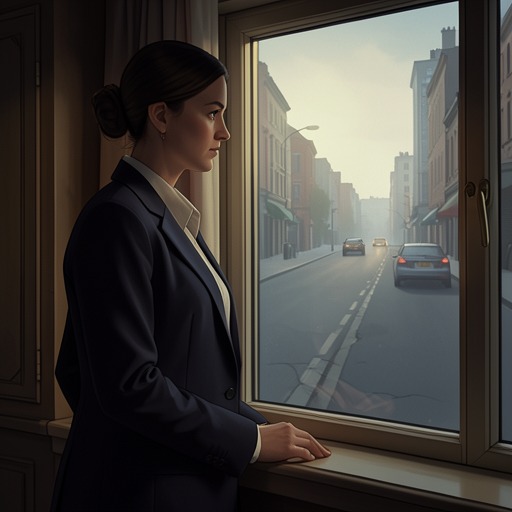
That belief shapes Anna’s response to Ethan. Looking across the park toward the empty windows of the Russell home, she imagines him inside with his parents and fears for his safety. Her concern turns the general lesson into an immediate hope: Ethan will need resilience to endure what has happened. Anna’s attention settles on the vulnerable child rather than on Alistair, a distinction that makes compassion, rather than an account of adult wrongdoing, the emphasis of her reflection. The principle is therefore both ethical and practical: resilience matters because a child may have to survive circumstances the adults around him have made dangerous.
Recovery measured in concrete changes
For Anna, starting over follows a long period of bereavement, depression, isolation, and self-neglect. She has waited for her family to return, though she knows they will not, and for her depression to lift on its own, though she now recognizes that it will not do so without her help. Her conclusion does not erase either loss. It changes what she believes she can do in their aftermath.
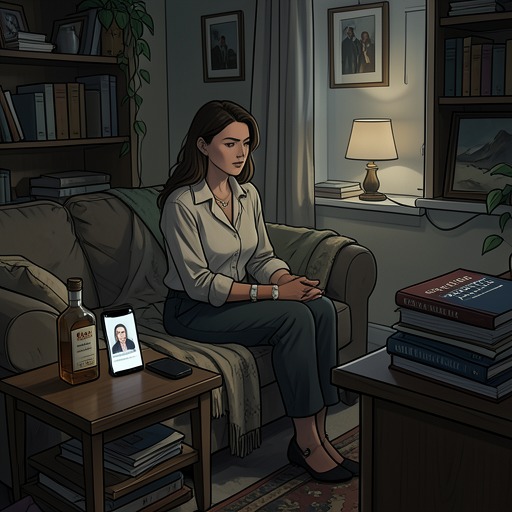
The six weeks before the closing scene supply concrete evidence of that change. Anna says she has become more stable and clearheaded. The skylight has been repaired, a professional cleaner has cleaned the house, and she is taking her medication properly. She has also stopped drinking, with help from Pam, the tattooed worker who visits her. These are distinct, practical measures rather than a claim that grief has ended: the damaged house is being put right, and Anna is attending more carefully to her health.
Her effort to reach David is another unfinished part of recovery. Anna has called him at least a dozen times to apologize, but he has not answered. She wonders where he is and whether he is safe. Finding his earbuds beneath the basement bed, she takes them upstairs and places them in a drawer in case he calls back. The small act preserves the possibility of contact without pretending that reconciliation has occurred. Starting over here includes acknowledging a relationship that remains unresolved.
Choosing to live rather than wait
Anna’s decision to leave the house is connected to her earlier survival. She recalls Bina’s point that, on a rainy night on the roof, Anna fought for her life. From that fact she reasons that she must not want to die; if she does not want to die, she must begin living. The reasoning is plain, but its force comes from the distance between surviving a crisis and making a choice about what follows it. Survival is not yet a return to ordinary life; it becomes the ground on which Anna can decide to act.
The moment also marks a shift from passive expectation to participation. Anna had waited for her family and for her depression to change without her intervention. Now she identifies a task she can undertake herself: rejoining the world. Her resolve is supported by the conditions around her—she is clearheaded, the sun is shining on the house, and Bina is with her—but the decision is Anna’s. The scene presents help and self-direction together, rather than treating recovery as either solitary willpower or something another person can accomplish for her.
The first step beyond the threshold
At the door, Anna counts to four, a familiar coping ritual that accompanies the approach to the outside. Bina releases Anna’s hand and walks into the garden, leaving footprints in the snow before turning to beckon her. The sequence makes the step visible and specific: Anna moves from the top of the stairs to the doorway, closes her eyes, opens them, and steps into the light.
The ending gives resilience a modest but decisive form. Anna does not claim that her family has returned, that David has answered, or that her depression has disappeared. Nor does one step prove that future steps will be easy. What changes is that she no longer treats waiting as the only available response. The garden and the light do not cancel the losses inside the house; they mark a first movement beyond its confines, made possible by Anna’s decision to begin living and by Bina’s steady presence. Resilience thus connects the child Anna fears for with the adult she is trying to become: not invulnerability, but the capacity to endure and to take a next step.